When it comes to protecting sensitive content in email communications, two encryption methods currently lead the list: S/MIME and PGP. Both methods ensure that only authorized individuals have access to the message and its attachments. But how do the two systems differ—and which is better suited to everyday business operations?
What is S/MIME?
S/MIME stands for Secure/Multipurpose Internet Mail Extensions and is an internationally established standard for secure email communication. Using digital certificates, S/MIME enables two key functions:
- Encryption: Only recipients with the correct private key can read the email, ensuring the content remains confidential.
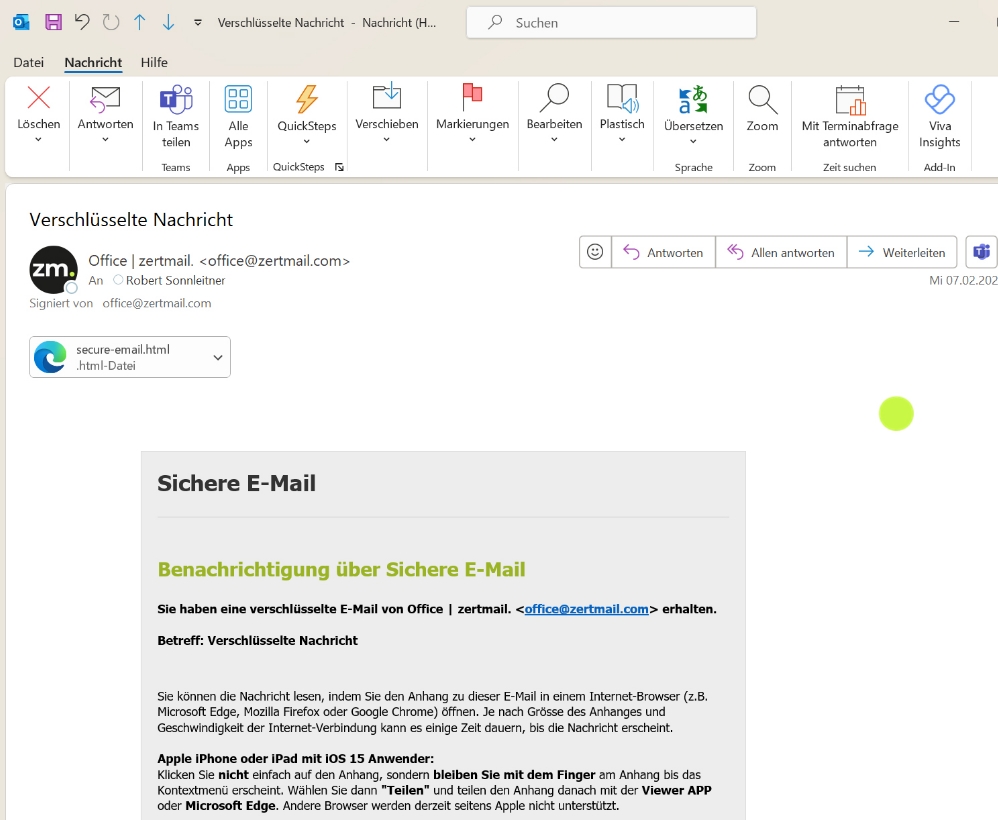
- Digital signature: The sender proves that the message actually originates from him/her – and that it has not been altered since it was sent.

S/MIME thus protects against both unauthorized access and manipulation – two essential requirements in digital business communication.
What is PGP?
PGP (Pretty Good Privacy) and its open-source variant OpenPGP also use asymmetric encryption, but are based on a so-called “web of trust.” This means that instead of an official certification authority, users confirm the authenticity of their keys to each other.
This makes PGP very flexible, but often more complicated in practice: Especially in larger organizations, it can quickly become confusing as to who is using which key and whether it is truly authentic. Integration into common email programs is also not always seamless and often requires additional software or plug-ins.
The main differences between S/MIME and PGP
| Feature | S/MIME | PGP / OpenPGP |
| Trust model | Central Certification Authority (CA) | Decentralized, “Web of Trust” |
| User-friendliness | High – automatic integration into email programs | Low – manual key creation & exchange |
| Compatibility | Widely used in companies & software | Not supported by all email clients |
| Setup effort | One-time setup | Repetitive manual processes |
| Administration | Centrally controllable, ideal for companies | On an individual basis |
| Digital signature | Automatically possible with every email | Often needs to be activated manually |
Why use S/MIME? The benefits at a glance
Especially in a business context, S/MIME scores highly for its ease of use and maximum security. Here are the key reasons why S/MIME is often the better choice:
- Automated security in the background: After a one-time setup, S/MIME works automatically in everyday life. Emails are encrypted and signed upon sending – without any additional effort for users.
- Integrated into email programs: S/MIME is already supported by many common email clients such as Outlook, Apple Mail, or Thunderbird and therefore requires no additional software. This makes it straightforward to use and reduces the need for training.
- Certified identity through digital signature: Thanks to the digital signature, recipients can be sure that the message actually originates from the specified sender. Any tampering with the content is immediately detected.
- Compliance with legal regulations (GDPR, NIS-2, GtelG): S/MIME meets the highest data protection and security standards and is therefore ideal for the legally compliant handling of personal data and sensitive information – for example, in the healthcare sector, the legal sector, or when communicating with authorities.
- No hassle thanks to automatic certificate renewal: With zertmail. The organizational effort is also eliminated: the certificates are renewed and managed automatically – without your employees having to actively intervene.
Differences between S/MIME and PGP summarized at a glance
- Trust model: S/MIME is based on official certificate authorities, while PGP is based on a decentralized trust network.
- Usability: S/MIME functions largely automatically once configured, while PGP requires manual administration.
- Target group: S/MIME is more suitable for businesses, while PGP is more relevant for individuals and technicians.
- Security: Both methods are secure, but S/MIME also scores points for its legal compliance and standardization.
Conclusion: S/MIME offers clear advantages for professional applications
While PGP is a flexible option, especially for tech-savvy users in private settings, S/MIME is the more practical choice for companies, medical facilities, medical practices, and organizations. Thanks to centralized management, seamless integration into existing systems, and compliance with recognized security standards, S/MIME meets the requirements of modern email communication – efficient, legally compliant, and user-friendly.
If you want to send emails securely while saving effort, S/MIME and zertmail. are the right choice.
